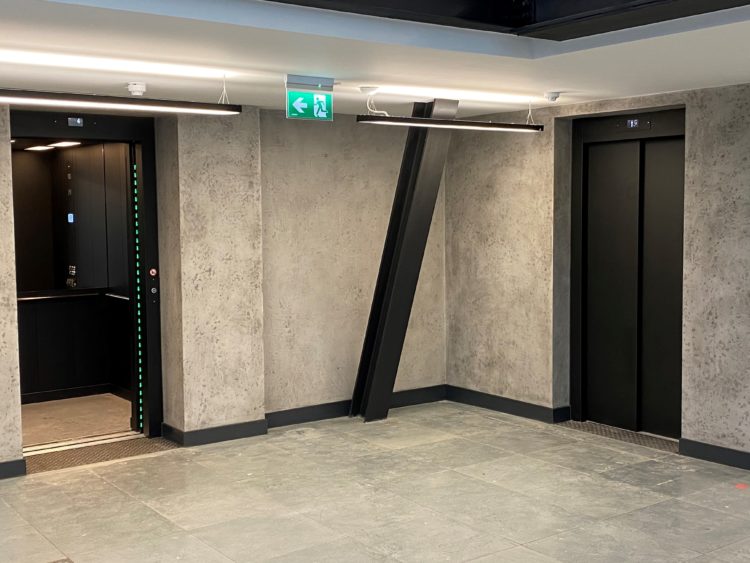

Hydraulic lifts remain a practical choice for low-to-mid-rise buildings, typically between 2 and 6 storeys. While contemporary traction designs are increasingly preferred for faster vertical movement in high-rise structures, hydraulic systems are still widely used for structural simplicity and the absence of overhead machinery, which also makes them less expensive.
Murray Lift Group is a leading independent supplier and installer of hydraulic lifts in London. We have collaborated with world-leading brands that produce sophisticated hydraulic lift components, including ThyssenKrupp (TKE), Kleemann, Kollmorgen, Otis, and others.
Whether you are a property developer seeking a bespoke installation for a new project or a building manager needing to modernise an ageing system, our London-based team provides end-to-end support. We don’t just supply the hardware; we also provide the technical rigour and compliance assurance—including LOLER inspections and preventative maintenance—that London property owners demand to keep their buildings moving safely.
Types of Hydraulic Lifts Available for London Properties
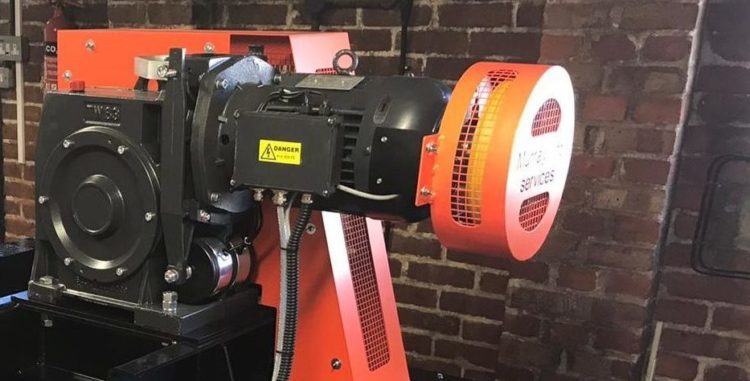
Hydraulic lifting systems fundamentally operate based on Pascal’s principle, which governs fluid pressure. An electric pump injects oil into a cylinder, thereby extending a piston that elevates the lift car. Although this technology originated in the mid-1800s, notably in London’s Victorian docklands, contemporary systems have undergone significant advancements, resulting in enhanced energy efficiency and compactness.
At Murray Lift Group, we provide full-service hydraulic lift installation in London, catering to both the residential and commercial sectors. Common types of hydraulic systems we work with include:
- Machine-room-less (MRL) hydraulic lifts: We can supply products like Otis HydroFit that don’t need a separate motor room and maximise floor space. Common uses include boutique offices, small commercial complexes and residential flats.
- Conventional Machine-Room Hydraulic Lifts: If your building has a basement or ground-floor plant room, a conventional hydraulic lift allows greater convenience for maintenance and relatively quieter operation within the lift shaft. Engineers have easier access for routine maintenance and repairs, reducing long-term service costs.
- Hydraulic Freight Lifts: For moving heavy goods, pallets, or even vehicles, hydraulic freight lifts are unsurpassed. They offer superior floor-levelling accuracy, which is essential for pallet trucks, and their “push from below” design means the building’s structure doesn’t have to support the massive weight of the load from the top of the shaft.
- Hydraulic Twin Piston Holeless (HAD): In many London locations, drilling deep boreholes for a traditional hydraulic jack is impossible due to underground tube lines, high water tables, or existing foundations. The Twin Piston Holeless (HAD) system uses two jacks located on either side of the car. This design allows for a standard lift pit depth, making it the perfect retrofit solution for existing London buildings.
Our engineers have full accreditation with CHAS, Safe Contractor, Construction Line, and LEIA memberships. All lifts installed will be CE / UKCA marked and include a 12-month parts warranty and maintenance within the contract.
Hydraulic Lift Services in London Offered by Murray Group
We manage the full lifecycle of hydraulic lift installation in London. Our team works alongside your contractors to ensure a seamless integration from initial design and concept to full-scale installation and quality inspection. A dedicated project management team will ensure a smooth handover. We’re here for all your hydraulic lift repair and maintenance needs in London.
- Installation: Our in-house design portal simplifies the process, allowing us to provide custom hydraulic lift installations with precision, tailored to your exact specifications regarding space, load capacity, and security.
- Expert Repairs: We keep a well-stocked inventory of genuine hydraulic lift spare parts from leading manufacturers. This enables us to handle all types of hydraulic lift repairs in London with efficiency. We often resolve minor issues, such as seal failures or valve blockages, on the same day.
- Proactive Maintenance: Our maintenance packages are designed for the London market. It includes system analyses, oil and seal inspections, safety gear testing, and many other parameters to ensure secure and smooth operations. Your lift remains fully compliant with LOLER (Lifting Operations and Lifting Equipment Regulations).
- Modernisation and refurbishment: Many hydraulic lifts in London properties are reaching the end of their 20–25-year lifespan. Instead of a costly full replacement, we can focus on effective modernisation with smart upgrades to controllers, valve blocks, and car interiors. We can also enhance energy efficiency by up to 30%, while strategically extending the longevity of your existing hydraulic lift.
Send Us Your Enquiry for Hydraulic Lifts in London
Whether you are in the initial planning stages of a new build or need an urgent assessment of an existing lift, Murray Lift Group is here to help with all kinds of hydraulic lifts in London. We provide transparent, competitive pricing and technical advice that puts the property owner first. Contact us for a detailed quote and technical advice.
FAQs: What London Property Owners Ask About Hydraulic Lifts
Can I install a hydraulic lift in a London building with a very shallow pit?
Yes. Many of our “holeless” hydraulic systems are specifically designed for London properties where deep excavation is restricted by basements or utility lines. We can often work with pits as shallow as 300mm-500mm, depending on the lift model.
Are hydraulic lifts noisier than traction lifts for residential use?
Modern hydraulic lifts are very quiet. By using VVF (Variable Voltage, Variable Frequency) drives and high-quality valve blocks, we can reduce the “jerk” and noise associated with older systems. When the pump is located in a remote machine room, the noise inside the lift shaft is almost non-existent.
How do hydraulic lift running costs compare in a commercial setting?
Hydraulic lifts are generally cheaper to install and maintain than traction lifts for low-rise buildings. While they use more electricity during the “up” journey, they use virtually zero energy on the “down” journey, making them a cost-effective choice for buildings with up to 4 or 5 floors.
What is the lead time for a new hydraulic lift installation in London?
The timeline from design and manufacturing to installation usually spans 12 to 18 weeks. That said, Murray Lift Group collaborates with several suppliers, including Kleemann and TKE, which allows us to frequently accommodate tighter schedules set by developers.